American Bittern is a medium-sized wading bird with a brown and white plumage. It is barely seen as it spends most of the time camouflaged in marshland vegetation but its distinctive call can be heard.
Table of Contents
Scientific Classification
Animalia
Chordata
Aves
Pelecaniformes
Ardeidae
Botaurus
Botaurus lentiginosus
Table Of Content
Table of Contents
Scientific Classification
Animalia
Chordata
Aves
Pelecaniformes
Ardeidae
Botaurus
Botaurus lentiginosus
Table of Contents
Local Names
American Bittern has been given various names like “Bogbumper”, “Stake Driver”, “Botam Tauri” and “Grobek”.
Species
American Bittern belongs to the Ardeidae family.
Description
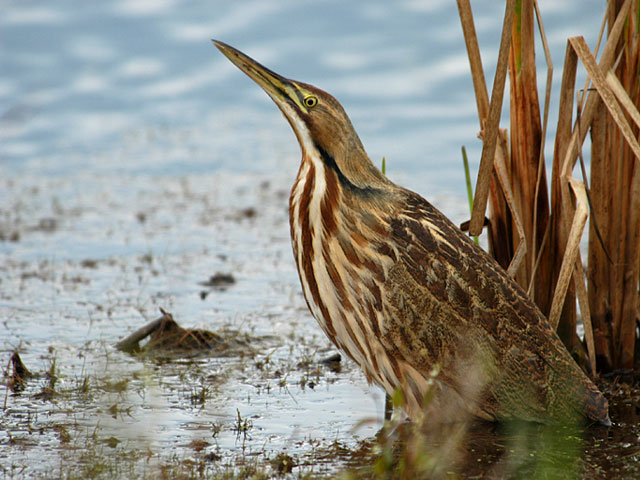
American Bittern has a sturdy medium sized body. An adult American bittern has a brown plumage with fine black flecks. It has a rusty brown crown, dark brown outer wings and a lighter brown in the inner wing and the body. It has yellow eyes, a pointed yellow bill, stout neck and relatively short legs. It stands around 2.5 feet long from the tip of its bill to the end of its tail with 3 foot wingspan. It weighs about a pound.
Picture 1 – American Bittern Source – home.comcast.net
Distribution
American Bittern are found across parts of United States and Canada. They range from Southeastern Alaska to Newfoundland, Canada, and California to South Carolina. They migrate during the winters to parts of Pacific Ocean, Gulf Coast, South Atlantic Coast, Southern Mexico and Caribbean.
Habitat
American bittern can be found in freshwater wetlands, pond edges with aquatic vegetation, marshy areas, hayfields and wet meadows.
American bittern has a life span of approximately eight years.
Reproduction
The breeding season starts from mid Aril to early may. Infidelity is common among the males and they have several females nesting in various locations in the same territory. The courtship of the American bittern is rarely displayed. While mating, the male bends it back, shortens its neck and moves closer to the female. Their courtship is followed by an aerial display. They lay about 3 to 5 eggs. Incubation last for about 24 days.
Nesting Habit
American bitterns build their nest in isolated marshy areas and ground near the wetlands. Females build the nests which are raised 6 to 10 inches above the ground with grasses, sedges and reeds.
Call
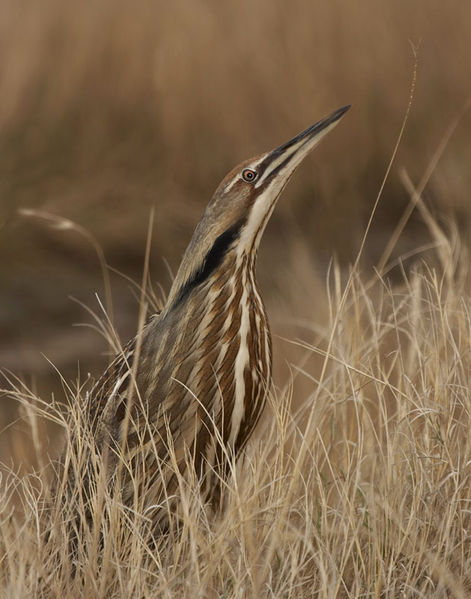
American bittern are known for their distinctive call. Their vocal has often been compared to a congested pump. Their low pumping calls are recognizable and can be heard during the dusk, around the marshes and lakeshores of Canada and United States.
Picture 2 – American Bittern Photo Source – 3.bp.blogspot.com
Migration
Migration pattern of the American bittern are not specific however long distance migration of the bitterns of the northern region where the temperature dips below freezing point has been observed. Bitterns of the southern region where the temperature is mild, appear to be non migratory.
Predators
American bittern have avian predators like peregrine falcons and great horned owl. The eggs may be attacked by raccoons if they are accessible.
Interesting Facts
American bitterns use reverberating sounds to communicate with each other and therefore have earned them various nicknames like thunder-pumper, stake-driver and mire-drum.
Unlike other herons, if approached or if they feel that they are being watched, they prefer to stand motionless with its bill pointed upward and sway as if to imitate the waving reeds.
During their courtship they display a remarkable aerial show.
It is a solitary and secretive species that can be heard but barely seen due to its well- camouflaged heron.
No sub species of the American bittern are known however fossils found in the Ichetucknee River in Florida were discovered as one of the prehistoric sub species of the bittern which existed during the Late Pleistocene period.
Both the sexes look alike
Adaptation
American bittern stands motionless with their bill pointed towards the sky. Their plumage provides them a camouflage in the marshes.
Endangered
The population of American bittern has declined considerably over the years due to loss of habitat. The wetlands, marshes and swamps have been removed for construction of roads, bridges and commercial development. Degradation of its habitat due to chemical contamination, Eutrophication, human disturbance and siltation has reduced its habitat quality. Acid rain affects the wetlands; hence the food quality and the habitat of the American bittern are damaged.
Conservation Status
American Bittern is a migratory bird therefore it is a shared resource by different countries. Measures must be taken by both the countries to conserve it. American bittern has been protected under the Migratory Bird Treaty of 1918. State of Michigan has enlisted it as the species of special concern. In 1987, US fish and Wildlife service, listed American bittern as a Nogame Species of Management concern.
Pictures
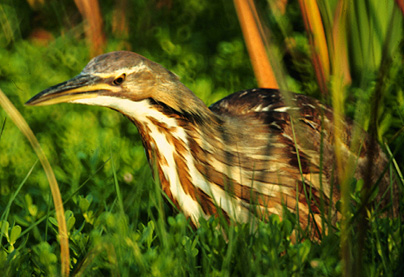
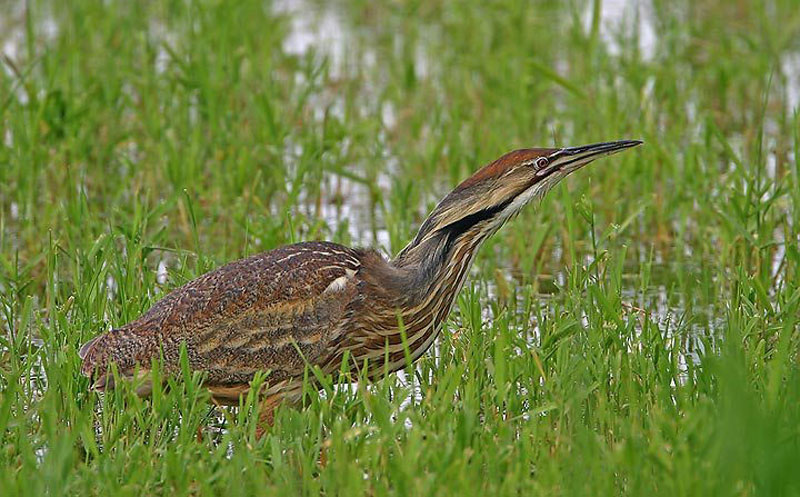
Here are some beautiful images for American Bittern:
Picture 3 – American Bittern Picture Source – inhs.uiuc.edu
Picture 4 – American Bittern Source – fishandgame.idaho.gov
We live on a lake in northern central Michigan and have never seen the Bittner on the lake before today. Seen one this morning in the yard at the lake shore and now we seen two in the same location. Is it common to see these in Michigan? I’ve lived on this lake for years and this is the first time we were fortunate to see these birds.





We live on a lake in northern central Michigan and have never seen the Bittner on the lake before today. Seen one this morning in the yard at the lake shore and now we seen two in the same location. Is it common to see these in Michigan? I’ve lived on this lake for years and this is the first time we were fortunate to see these birds.